Tuesday, December 4, 2012

End of Year Musings - Machinima 2012, Part I


The first of a two part series....musings on machinima

The year has passed by so quickly.   Machinima as a form of expression has been very good to many of us.  Some of us have created machinima communities in which we engaged in dialogue and collaborated on various projects.    I enjoyed revisiting the 2010 Yuletide production "TheNight Before Christmas..." by Celestial Elf, who rewrote Clement Moore's classic poem. Voicework by Cisko Vandeverre should be applauded, as well as Celestial's strong cast of performers and contributors.  


Two years have passed since then, and Cisko announced his plans to leave behind SL at the Machinima Expo.   We hope that he reconsiders, for the future has only begun for machinima in virtual worlds.  Marshall McLuhan would see such spaces as pathways of extension for the media maker and audiences.   It is the space within, and that space emerges from within our imagination, tapping into fears and fantasies, while elaborating notions of reality.    Media has always been iconic of human life.    It is somewhat representative at best.

For me, the art of virtual life is expressed through writing and the imagery that complements it, propels and projects it from one's imagination onto our computer screens.    Last year in December, I madly wrote and published a storybook photographed in Second Life (a sort of children's tale with an adult message regarding technology), with Lowe Runo, Belinda Barnes, and Kara Trapdoor helping to set up the shots with animations.   Live action was photographed, and the photos richly illustrated the words.   Words and images can be wonderful allies, neither should be dismissed as insignificant.    


This year's Machinima Expo showcased the beauty of imagination in all its forms and platforms.   The complete list is available at MachinimaExpo.com.   All worthy of review.  The Jury Prize Winners were "The Last Syllable of Recorded Time" and "MetaSex" by Tutsy Navarathna, "Unfinished Painting (Dreaming in New Orleans)" by Miron Lockett, "Wulf and Eadwacer" by Hypatia Pickens, with the grand prize winner being "The Chapelside Deception" by IceAxe  (Iian Friar).     The Audience Choice Award was  presented to Friar for "Unfinished Paintings."  

In "Wulf and Eadwacer," Hypatia explores the power behind words;  image and motion intensify  the audience's experience.    Ancient words and worlds can be relived in Second Life, and in the film world in general.     Imagination is not bound by time, set, or any sort of visual platform - or language for that matter.   

Machinima at its core goes back to the idea of using a machine to produce cinema.   Yes, it started with game play, but it could not be contained to that.  Machinima's beauty has evolved into an opportunity to freely create what we imagine, and to share it with others or merely ourselves (projecting our imagination outside of our being into our computer).    The "machine" has become a McLuhan extension to our goals, needs, wants, desires, and budget.     Ideas are captured.   Beauty is in the eye of the beholder.     Beauty is also disarming, and sometimes we forget the idea - the substance - the message - must go beneath the surface, to the depth of one's soul.    Can  machinima do that?   Well, ask yourself, can the cinema do that?   That is your choice.   Numerous books by film scholars have been written on the topic, and now machinima finds itself at the heart of such discussions.   


A book worthy of note along this regard is Dr. Jenna Ng's  (December 6th, Continuum) Understanding Machinima:  Essays on Filmmaking in Virtual WorldsHer edited collection begins with Dr. Henry Lowood's Preface, who had previously edited another collection called The Machinima Reader (with Dr. Michael Nitsche, MIT Press, 2011).  Nitsche contributes to Ng's book, and at least a couple of essays discuss Second Life in particular (based on titles).  The academic community furiously unravels machinima  as a critical form of expression(at least in long form, for trade essays and journal articles preceded these recent books); its significance to one's viewing experiences, as in how identity, society, and the very essence of storytelling become portrayed, provokes us further to elaborate on its role in contemporary media. 


Such books are well needed for critical discussion, especially at this juncture in machinima's evolution. The book  Machinima: The Art & Practice of Virtual Filmmaking (with Lowe Runo, my co-author and inspiration) - leans toward the practical matters of making machinima, with special emphasis on storyboarding, character development, sound, lighting, post production, copyright issues, exhibition, and education.   Knowing one's craft, understanding practice, is critical to the making of visual fabric. Practice and art inform one another. 

For a good summary of our book, read the review by Machinima Expo Co-Founder Ricky Grove's (M.A. Yale University/Hollywood actor/bookseller) at Renderosity.    We also appreciated the kind words of Dr. Sarah Higley, who reviewed our book in a forthcoming volume of Journal of Gaming and Virtual Worlds.   Moreover, look for her chapter in Ng's edited collection.   

As the year closes, it is appropriate to appreciate "Machinima" in its various conceptions  - as a metaphysical concept that bonds us on one level philosophically and at another level separates us technically.  To me, a partaker of Second Life, it is a means toward opening one's senses to virtual expression in all its diversity.   This avenue would seem to hint toward the need for balance between method and message, with the greater goal being the latter.  Most machinima films (and derivatives) appear online; the Internet has fostered an emerging community of independent producers. "A new story is beginning to emerge," stated Dr. Howard Rheingold in 2008 on Ted.com.  He spoke then, and continues to lecture, about the changing model of media making and communication, in which collaboration and participation are central.   Rheingold has long inspired me, and is one of the first to explore the collective undercurrent that drives the Web.   


Media Arts in the Virtual Life

I know machinima making and viewing has helped me appreciate the virtual world in which I work and reside - Second Life.   I have written two books related to virtual worlds;  the first one being solely dedicated to media's role in Second Life, and the second springing from Second Life's machinima community and extending to other virtual worlds and platforms that allow for innovative and interactive film experiences among in-world actors and filmmakers - and on the horizon audiences more participatory than thought possible. 

As 2012 departs, let us not forgot how education can help define and critique our craft, as we learn from one another in a distinct community of virtual filmmakers, where the novice and the professional showcase their work together.  Jay Jay Jegathesan is at the helm of the University of Western Australia's collaborative spirit in bringing together (and building) a large community of machinima (and virtual arts) enthusiasts. As Manager of the School of Physics, his art-science-technology triangulated perspective is actually indicative of Australia's pronounced move to become a leader in digital culture globally.  The University of Western Australia has its virtual base of operation in Second Life.  That might change in the future as new worlds emerge, but it has accepted the challenge of being on the forefront of the media arts - and thus UWA participates toward virtual development along this line and has done so since 2009.

Ray Bradbury's Fahrenheit 451 tells of cinematic and theatrical living room experiences where an individual engages with the screen, role playing within the film or TV show with other characters. To me, that possibility exists within Second Life, as well as other virtual worlds in the near and distant future. If nothing else, science fiction authors have taught us - first we must imagine. Move beneath the surface, below the epidermis that protects us, to the depth of the message. Technology should follow, not lead. The story crafted in-world should not be bound by what some see as technological limitations - whereas others perceive them as challenges. The future of storytelling should hold promise for those daring to experiment. Failure leads to success. Success sometimes leads to the mundane and trite. Every good character actor knows that it is important to live the part, and in Second Life that is achievable. Cyber-cinema may influence and shape our messages to a certain extent. As we become more immersed in virtual experiences, the cinematic machine (think Jim Carrey in The Truman Show, 1988) - always present - will be seemingly invisible, be that good or bad.  I hope there will always be a strong community of independent media makers in the virtual realm. 


To be continued....Part II, next week.  


References

Elf, Celestial. (2010, November 28). The Night Before Christmas.  Accessed,   http://www.youtube.com/watch?v=LJLiLa7G5Ig&list=PL35566945865FF7C0&index=2&feature=plpp_video

Grove, Ricky. (2012, July 30).  Book Review.   Renderosity.   Accessed, http://www.renderosity.com/book-review-i-machinima-the-art-and-practice-of-virtual-filmmaking-i--cms-16274 [also, http://www.rgrove.com/Renderosity/Machinimabook_Review_FinalDraft.pdf]

Machinima Expo Programming.  Available at Livestream.com.  Accessed, http://www.livestream.com/themachinimaexpo/video?clipId=flv_802b522e-fb47-46d3-9c59-8360cc1e4fbb&utm_source=lslibrary&utm_medium=ui-thumb

Machinima Expo.   Web.   Accessed November 20, 2012, http://www.MachinimaExpo.com

Machinima Expo Winners, http://www.machinima-expo.com/

***
The Professional Machinima Artist Guild and Lowe Runo Productions graciously host Magnum: The Machinima Review.  Sonicity Fitzroy (SL), author of Second Life, Machinima and the Other Society (Peter Lang, 2010), and Machinima: The Art and Practice of Virtual Filmmaking (with SL's Lowe Runo, McFarland, 2012).  Amazon.com. See, author's page:  http://www.amazon.com/Phylis-Johnson/e/B001HOW4U2/ref=sr_tc_2_0?qid=1354606175&sr=1-2-ent


Thursday, November 1, 2012

GA-GO and The Machinima Expo


On November 16-18, The Machinima Expo will feature a number of talented machinima artists, and one of those videos were produced by Takuma ”Gago Gigamon.” G-Project 2012 “End of The War” was among the films nominated in the 2012 Machinima Expo. For this project, Takuma tapped filmmaker SL MAG’s umekobutya Beck, an extremely talented Japanese machinimatographer. Takuma edited the film, and did the sound design.

You can watch the video here:  [http://www.youtube.com/watch?v=jl1mimqvn_c]. 

A Word About The Expo
The Machinima Expo was founded by RICKY GROVE, an amazing man himself.   He’s proudly an ex-Hollywood actor after a long successful “film/TV” career, and today he is on the most wanted list for machinima voice talent.   Ricky likes the independence that machinima provides the producer.  Now, a big part of Ricky’s life has been producing Machinima Expo, in its fifth year.   The 2012 expo producers were Ricky Grove, Pooky Amsterdam, and Kate Fosk.  The screening team was Sean “Armanus” Heimbuch, Damien Valentine (Darth Angelus), Ricky Grove, thebiz, Eddie Dugan, and Kate Fosk.   I was honored to be part of the juried panel, and in very good company (Joseph Farbrook, Frank Dellario, Susan Johnston, Phil Rice).    


See the Machinima Expo site for info on the upcoming festival, and who’s who and what’s what.   When you are there, check out Hypatia Picken’s commissioned trailer promoting the festival.   I also had the wonderful honor of interviewing Ricky for the November issue of Best of SL Magazine in the on-going series, Masters of Machinima.   Read the complete BOSL feature story online or in-world.   Pickens was featured in an earlier BOSL edition.

The thing about The Machinima Expo, especially for SL filmmakers, we get to see what others are doing in other platforms – and they get to see what we are doing inside Second Life.   There is a long tradition of live music in Second Life, and with talents like The Follow, Mankind Tracer, and many others – machinima seems to be a creative tool that has helped in the promotion of these bands.    In another sense, a good story told through music, with some good visuals, offers great potential for bringing together audio and visual elements in unique presentation.

Going GA-GO for Machinima

Music and Machinima go together like birds and feathers, hot dogs and baseball, apple pie and Mom, and so forth.    Sometimes you happen upon an event that sparks your interest.   This time, the spark for this column came from my interview with Ricky Grove, and began to evolve from there.   All the pieces – machinima and music and the Expo fell in place last Friday when I was teleported into an amazing event by Belinda, a.k.a. producer of Gangnam Furry Style SL machinima.  She makes no apologies for her love of music and machinima, and a heavy dose of post-production.   So, of course, she would bring me to the GA-GO concert.   It was part of a larger live music event that day, but what got our attention was - its founder Takuma “Gago Gigamon” calls his band – a machinima band.  He literally put on an explosive show, lots of lights and even GA-GO dancers! Pounding beats, lots of enthusiasm and a Westernized rock-n-roll high fashion sense were other ingredients.

One can trace the art of dance to the visual arts historically, and more recently contemporary media has illustrated the relationship between music and film through the birth of MTV (which is so far from its original mission, but that is a different story).    I could further point to the link between animation and music, and that too has had a long path.   Think Beatles.   Think Pink Floyd’s The Wall.   Full Metal Jacket – does that ring a bell?  That’s only a few examples.    Some producers have enhanced silence films with soundscapes and music-scapes transforming the meaning of the visuals.   I consider music machinima as an important aspect of our media culture, popular and alternative.    I wrote in depth about that in my book, Machinima (with L. Runo, McFarland, March 2012), and I credit much to R. Murray Schafer (Tuning of the World, 1977) and Paul Miller (a.k.a. DJ Spooky, MIT Press) for opening my ears to a whole new sonic world more than a decade ago.  

Add to that, I had an opportunity to study the influence of Japanese sound culture and music on Western culture; I found that an extraordinary learning experience.   Henry David Thoreau’s was inspired by Eastern philosophers and their ways of turning into the environment.   For Thoreau, he tapped also into the burgeoning industrial soundscape of modernity (a phrase coined by sound historian Emily Thompson).    Japan is both a visual and listening culture.   There is a respect for silence in public places, along with a continual appreciation of natural environments and their sonic persona.    It is a sense of knowing time and place, understanding the need for silence on one hand, but totally getting the need to push the envelope at times.  There is a time to totally let loose and let technology have its say.   The surge of creativity can be heard and seen through anime and other visual art forms.    Music is shared via those experiences.


Japan’s Visual Aesthetic 
In the book Japanese Visual Culture: Explorations in the World of Manga and Anime (by Mark W. Macwilliams, 2008, M.E. Sharpe), there is a quote by Jean Marie Bouissou that makes note of the Japanese “aesthetic of excess, conflict, imbalance, and overt sensuality.” Some of that visual aesthetic is captured in GA-GO’s machinima, filmed by SL MAG’s umekobutya Beck. There is definitely a Western sensibility in the machinima, and plenty of James Bond-like action. Takuma is a RL rock singer, and he puts on a high intensity rock show in SL. That kind of feeling is captured in the well-produced machinima.


The band members, aside from lead singer Takuma, include Keyboardist Setsuna Infinity, Guitarist Ark Foden, and GA-GO Dancers Pyson Camel and Sizuku3.Vella. The band’s manager is the lovely Yumi Yumichan Allen.

Takuma told me, “the ‘possibility of new music’ can be pursued in the virtual world. ‘GA-GO SL Ver’ is a Japanese machinima rock band.”   The band is a virtual take of the RL band, and it’s based on the “hot 80's rock music scene, with a very heavy, loud sound and experience in entertainment,” and when you can hear Takuma “shout out and the audience responds in Second Life,” he says, “It's insane!”    He enjoys the diversity among his listeners/viewers, and hopes his music “resounds in the souls of young and old who find this an exciting dream in a chaotic age.”

The band members in SL differ from RL members.  The SL members are builders and creators, and help with the lighting, dance and overall production of the show.  Setsuna is a builder who has been involved in the creation of the Miss Virtual World stage and the sim build for the Ashraya Project.

Takuma feels fortunate to hear his songs in SL, for it has made possible what he thought to be an impossible expression.   To him “the place of expression is Second Life,” a virtual world that allows for new music and new ideas.

In RL, the band is simply known as "GA-GO" and they are very active in Kansai, Japan.

Special thanks to Sakurako Watanbe, owner of the Kumashon Shopping Mall, for hosting the SL event shown in some of the above photos (taken by S.F.).

*   *   * 
Official GA-GO Web Site (translated)

Machinima Expo

BEST OF SL Magazine

Bel and I will see you at the MACHINIMA EXPO.

The Professional Machinima Artist Guild and Lowe Runo Productions graciously host Magnum:  The Machinima Review. 


Sunday, October 7, 2012

Bump in the Night

Things that go bump in the night! 


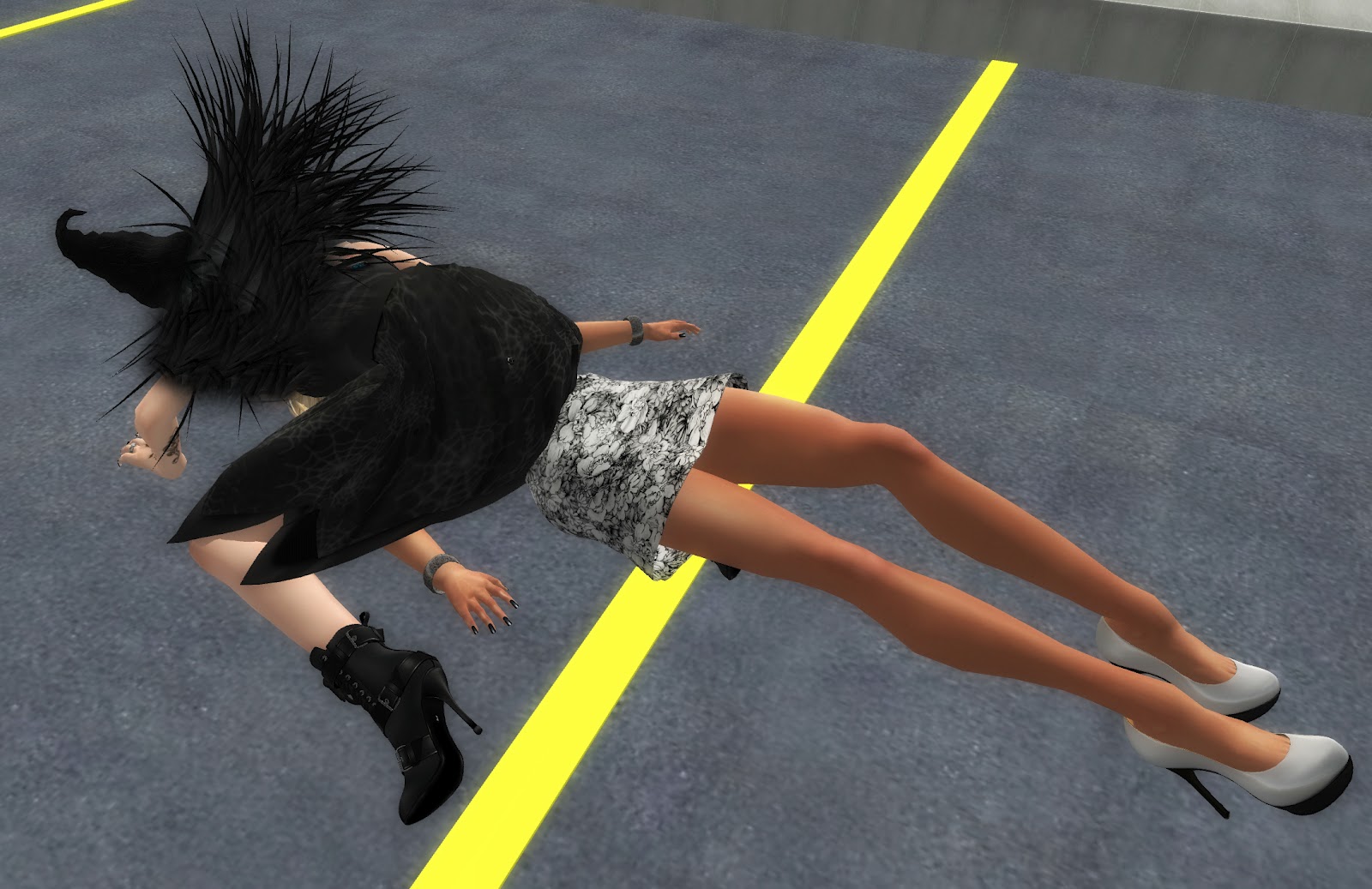
I'm back from a month hiatus to take on the Season of The Witch (2011), not the motion picture starring Nicholas Cage.  I was one that enjoyed it, but the critics and viewers were mixed in their reaction. A much larger issue is at hand, as the bewitching hour draws closer to us.  What is it about horror movies that give us tingles up our spine?  Good and bad scary movies have an effect, with some more subtle than others.  Whether we love them or hide from them, during the Halloween season, they surround us from movie trailers to costumes to fake spider webs.  The reality is - the images and storylines don't have to be that "real" to frighten us.  Think about all those "Jason" and Freddy" movies - and what about "The Candy Man" or today's generation's reincarnation of the ancient "Slender Man" - we suspend disbelief to believe in the dark side.  Even in the virtual world, the Wicked Witch of Second Life might get you, my pretties. 

The plots seem trite. The victims are paralyzed with fear, and we think we would do something differently;  we would run faster (and not trip on that tree branch) but then we think, would we, could we?  Horror movies tap into our wildest fears, even worse than any nightmares conceived within our mind - alas, it comes from the human mind, that writer who knows those little twists and turns to get us on edge.   The ghastly figure peering into our window, the doll under our bed that comes to life when we sleep, or even the creature that looms within the depths of the lake - all bring to mind familiar movie scenes.   If one believes in good, then surely there is evil.  If one believes in evil, then there must be some goodness in the world.   One or two characters escape from this horrid wrath, only to be faced with those demons again and again in sequels.


We laugh about some of these movies, and how silly they are, but we watch them - and jump at the appropriate times.  Our primal fears are aroused by sound and light, and some instinctual sense rooted deeply into our being.   Do you ever think - could I ever do such dastardly deeds, if pushed beyond my limits?  What are those human limits?  Do you ever know?   In comic books and films, there are supernatural transformations into superheroes  - and then there are those humans that become supernaturally evil and powerful, driven by revenge and psychosis.  Maybe there was something evil in them from conception.  Freud spoke of our id, the darkness closeted deep within our mind.  Is it that part of us that enjoys these movies?

Earlier this year, Time Out London published a list of the top 100 horror films, and the top ten are worthy of reflection this Halloween -  The Exorcist (1973), The Shining (1980), The Texas Chain Saw Massacre (1974), Psycho (1960), Alien (1979), The Thing (1982), Rosemary's Baby (1968), Halloween (1978), Suspiria (1976), and Dawn of the Dead (1978).

Check out the whole list here: http://www.timeout.com/london/feature/2494/best-horror-films.


"Bad people don't come with warning labels." 

I heard that line today, as I wrote this column, watching a Lifetime movie!  That is a network full of movies that by its design asks us to put our critical sensors on hold!  LOL.  I have come to learn many men watch this network too, as well as its target audience of women of many ages.  Only those brave men admit to it!

What is it about horror movies that captivate our attention and scare us out of our mind.  EXACTLY.  A horror movie is a step into madness, a point were human weakness and strengths are exploited.  It is the pounding of the heart in Edgar Allen Poe's Tell Tale Heart.  [Here's a The Sims 2 adaption - a pantomime]  It is our humanity that allows us to fall prey to the supernatural.  It is more than the eerie music, whispers in the dark, the blood and writhing, flickering lights and shadows, or even the infamous Wilhelm scream.  In the world of horror, we can trust no one - not our lovers, children, or parents.  We are alone - and not alone.  We are sane - and perhaps insane.  We cannot even trust ourselves.  Vampires did not make the top 10, but Dawn of the Dead did.  Perhaps it is because what scares us most is ourselves, those of our own species. Vampires live eternally, and zombies are mindless, drooling creatures.  We hold life precious, fully rich with emotions and intelligence.  Those emotions include fear, and the absence of fear is to be a zombie. A vampire fears its second death.

Now let’s look at some horror machinima from the past few years.  The range of skills and content are quite diverse.   


Above, World of Warcraft's This is Halloween - a musical ditty that you will recognize.
http://www.youtube.com/watch?v=wlZ2wSHw7YI


Above, A Sims 2 Horror Movie
http://www.youtube.com/watch?v=0ivkpVzgyRQ&feature=related
The windows scenes are worth the view.  Why did they leave the door open?


How about a couple of H.P. Lovecraft adaptations?  We start of course with the work of the wonderfully talented Lainy Voom, in particular her version of Dagon.  It is an artistically crafted voyage into the mind.  Or what about the award-winning series The Shadow of Innsmouth and its prequels screened at the Machinima Expo over multiple years.

And then one of my students, Patrick, this past summer experimented with a bit with horror, first using Minecraft to produce a music video (Skillet's Monster) and then Second Life to create a sci-fi mini thriller.   Realize that these were his first machinima projects.

Minecraft – Skillet's Monster
Second Life - Horror on the Bridge


Note the cameo by my co-instructor Lowe Runo in "Horror on the Bridge."  Lowe himself produced a machinima years ago called Bedtime, playing off our childhood fears. We all have at least one scary story in us - what is your story?   

We find reasons why to celebrate Halloween all year-round.   This November 30th, Black Friday, the biggest shopping day after Thanksgiving, The Collection will be debut in movie theaters.   And its logo is..."the real Black Friday."   

What can we learn from horror movies?  - techniques of foreshadowing, building suspense, tapping into fears, unique characterization, and how to take us on the emotional roller coaster ride of our lifetime.  That does not necessarily mean lots of action in the physical sense.  It means an exploration into the primeval nature that connects us all.   As we face our greatest fears, there is hope that the human race can rise above them all, to start again - until Part  II.


Be sure to attend Machinima Expo inside Second Life - November 16-18th, and visit the Web site at http://www.machinima-expo.com/

*    *    * 
 Thanks to Belinda Barnes-Fitzroy for posing in some of the photos.   By the way, here's a playlist of my students' projects from the summer, with most of them dabbling for the first time in machinima -  http://www.youtube.com/playlist?list=PL00535DE7B042CF43&feature=plcp.  

*    *    *
The Professional Machinima Artist Guild and Lowe Runo Productions graciously host Magnum:  The Machinima Review. 

Saturday, August 25, 2012

The Many Masters of Machinima - continues


Summer is nearly to a close. The year is swiftly passing by.   I thought I might do a mid year check on the pulse of machinima.  I enjoyed the University of Western Australia's machinima competition once again - MachinimUWA V: Seek Wisdom exhibited more than 50 works.  Major applause to SL UWA Founder Jayjay Zifanwe for all his time and resources for creating a strong community of virtual artists and filmmakers.  One of the things I am personally proud of, is Best of SL Magazine's addition of a feature spotlight called, Masters of Machinima.   I don't always select the person who will be featured, but I have been pleased with the nominations and selections.  They represent a diverse group of seasoned, up-and-coming, and new talent.  It would be impossible to feature everyone, but I hope the series will continue for a long time. Just the idea of promoting the concept of machinima is refreshing, and it continues to be a goal of mine to promote the art and practice of this medium and its potential.  

The August BOSL featured the abstract music machinima of JJccc Coronet.  His love and talent for abstract art is projected in his moving images.  His work is also featured on Duran Duran's latest DVD Diamond in the Mind, as well as at its RL concerts.    JJccc, you might easily say, is the official machinimatographer for Duran Duran.   You can find him filming at nearly every Duran Duran Universe (DDU) event in Second Life.  The photos below are mine from Nick Rhodes' 50th Birthday Bash.  Rhodes is a key founder of the band Duran Duran.  JJ is the big red guy!  As you can see, these events get a bit wild.  Head to his channel here. 


In fact, DDU Community Manager Chrissy Welinder told me, “Nick is crazy for his videos and after every event the first thing he asks me is, 'Has JJccc made a video?'"   By the way, Nick Rhodes is the founding band member and responsible for bringing Duran Duran band members into Second Life and for the creation of the DDU, along with Chrissy.    

In July, the BOSL focus was on Star Wars' fame Tony Dyson and MaMachinima's Chantal Harvey, and I blogged about their new adventures with the BobbeKins (see prior blog).  

June brought us a focus on MAG Founder/Filmmaker Lowe Runo, co-author of Machinima: The Art & Practice of Virtual Filmmaking (McFarland, 2012).   Ricky Grove and Kate Fosk interviewed us recently for their Machinima ExpoCast (podcast) series on SoundCloud and posted on their Web site. The duo are extremely well versed in the going-ons of machinima so definitely make plans for Machinima Expo 2012.  It's the fifth anniversary, and this year events will be still held in SL, but also streamed live across the Web.   Submission of machinima continues through September 30th, midnight.   And the expo is scheduled typically in November.  Check their Web site for details.  Psst. Ricky Grove's voice was featured in last year's grand prize machinima - BiggsTrek's The Haunter of the Dark, and an exceptionally well done nearly 30 minute story based on Lovecraft's work.


And you gotta love the Expo's 2012 promo - The Moon - by machinimatographer Tom Jantol.  He has been a big part of the events in the past.

Then in May, we had Emanuelle (Ema) Courtois (above), an amazing young woman filmmaker who brings new perspective to machinima.   Her fashion machinima has brought her real life opportunities and kudos.
She has had a long relationship with music and imagery, and machinima allows her new creativity. 

April focused on Hypatia Pickens, known for her stunning machinimatography, rich storylines, and intriguing voice.  She crafts her machinima well, and it is her attention to the details that underscores her talent.


March, of course, started the series with Rysan Fall, one of the first and active members of MAG.   He rarely has time to surface for public events.   He is very engaged in his machinima craft and business.  He is definitely a professional machinima maker, and has worked years perfecting his talent - and as he would say, learning from others in the machinima community.

Coming in September, BOSL's Masters in Machinima features Tutsy Navarathna.  He is a three time winner in the University of Western Australia's series of machinima challenges.  His winning work was The Last Syllable of Recorded Time in the MachinimUWA: V Seek Wisdom competition, and this coming issue will explore his philosophy of machinima and vision for virtual worlds in general.   
 Think of him as the Jim Morrison of machinima - more in the full-length feature.
There are so many more talented machinima makers, and machinima creativity can be defined and conceptualized in so many ways.   The future remains open with potential, and no matter the platform, be it a virtual world or not, machinima will continue to evolve.   


The SL Coming to Steam
With the Linden Lab's move to add Second Life to Steam, and with anticipated requirements for computers to handle higher resolution graphics, there may be some challenges as well as opportunities in the near future.   But the point remains, machinima will evolve regardless of a particular platform.   There are some opportunities for freedom and creativity that would be lost if the nature of Second Life moved away from the virtual world as we know it - and the Lindens considered Second Life merely another game platform.

Alas, much thanks should go to the Lindens for allowing machinima to flourish in this immersive environment.   It has given us a glimpse of things to come or at least possible.   Let's hope that the Lindens truly understand that Second Life is both a social and artistic world that brings us together internationally, in a way that machinima.com and Steam in and of itself cannot do.   The Lindens are truly ahead of their time, and in the coming years, Second Life will be appreciated as the first successful experiment in virtual worlds.

SL is nearly a decade old.   That is quite an accomplishment:  let the experiment continue to flourish so that many can be involved. Every medium needs an audience. Let's not merely be another machinima.com that targets a specific demographic, although they are an important part of the machinima population and marketing equation.  As Ricky Grove would tell us (see the SL Enquirer interview with Ricky, Kate Fosk and Pooky Amsterdam) there is much more out there for creative artists and filmmakers who use machinima for storytelling and communicating to a larger audience outside the gaming community.   Perhaps machinima might go for that television audience who has found its way to the Web.  There will always be programmnig that appeals to certain demographics, but let's make content that reaches beyond the members of our platform, whatever it is, especially at a time when viewers are drawn to quality animated features.

I would have to say, when I was growing up, I never really thought about existing - working and playing - in a virtual world.  But here I am.   I have written two books related to media usage in Second Life, and I feel that history has been made here.  I teach students here;  I interview wonderful musicians and media makers in avatar form as well as connect with their audiences.   I think one of the key moments for me in Second Life was CBS' CSI: NY, for broadcast television had extended its programming reach into an immersive environment, where viewers could not only watch the program but participate in it.   Now maybe it did not revolutionize broadcasting.  But once again, we were offered a glimpse of the future.  Tracing back the history of broadcast media, it takes quite awhile for adoption of new technologies for both economic and political reasons.

There is so much more ahead for us, and understanding that our own particular virtual sky is not the limit is a good start.   Saying that, Second Life is where many have us have put our time and energy - including me.  The caution is, technology always evolves.  I hope the Lindens realize what a jewel they have, and the gems include those creative people who have invested much time and resources so far.   It is a wonderful machinima playground that brings Tony Dyson, Nick Rhodes, and Ricky Grove - and so many other professionals and amateurs - to such an environment. Nevertheless, you can bet on technological and creative evolution; there's more to come....

The Professional Machinima Artist Guild and Lowe Runo Productions graciously host Magnum:  The Machinima Review.


Saturday, July 7, 2012

The Fantasy World of Star Wars' Tony Dyson

I had the pleasure of interviewing special effects guru Tony Dyson of Star Wars' R2-D2 fame and so many Hollywood blockbusters for the July issue of Best of SL Magazine.


Tony Dyson is definitely a master of machinima,  and now that he is teamed up with Chantal Harvey, MMIF founder and professional filmmaker, they have become the dynamic duo.


So what's their latest adventure - the BobbeKins, a wonderful journey into the fantasy world of children. You have to understand that both Tony and Chantal have a love for fantasy, positive storytelling, and inspiring and educating audiences through imagery.Powerpuff GirlsI think we often overlook the younger viewers when we think of machinima ideas.  When you really think of it, machinima is a form of animation, and animation has been enriching the lives of children for generations, from cartoons to Disney Classics to our newly emerging online characters in kids games.  Machinima has the potential to reach the young and old, and everyone in between.  Parents used to watch those Saturday morning cartoons with their children (on a television in the living room together - and enjoy them), if for nothing else the double meaning hidden in the dialogue and images.   Some of that still exits, but the movie industry has accelerated childhood to a great extent.   Few General Audience movies exist today.   Fantasy creatures and lands abound, yet few are inviting for children.

Machinima can reach out to some of those forgotten demographics and serve for not only educational uses, but just for fun!  If you are looking for inspiration, check out the top 50 cartoon characters of all time (now this excludes the great PBS children's programming that I grew up with, but it is an interesting browse back on what has captured our attention.)  I came across another site, called Common Sense, namely for traditional family values, and mind you I am not pushing any agenda.  But there's some good kids' shows in the mix.  Take what you want out - there's something for nearly everyone.   Pooky Amsterdam's crew has produced a wonderful teen series via machinima called Time Travelers.  She's get it.   But that is only one of the many genres that her company produces with machinima.  

So what's the point of this column.  Take some time out - and just think about all this.  Before you leap to your next project, take a moment and look at what some of your colleagues are producing - and what they are not producing!  Consider all genres for machinima, as you would any type of animated program and really any type of program, given that it seems appropriate to your audience.  All of us have grown up with animation, from cartoons, to music videos, educational programming, drama and so forth.

The thing is - there are no rules for machinima.   You have to be willing to put yourself out there, and see what works.   But that is the case of any filmmaker.   It helps to have passion on whatever your producing - passion about the story/theme and reaching your audience.  If you have that, and have the time and resources, then try it.  If you don't have time or resources, find someone who believes in your idea!  Just keep trying - isn't that something we would tell our children!    I guess that is our lesson today.   Keep moving ahead and know the future is bright, especially if you know the appropriate windlight setting.   Wink.   LOL.

What about machinima for girls!  Girls in the Sky was clever, and I would like to see more of that.  Then again, I was a Powerpuff Girl fan, and I love silly adventure starring girls.   Machinima is not limited by ages, and not limited to Second Life audiences.   Tony and Chantal have it right to go for a new generation of viewers, and their hearts are pure with good intentions in using Second Life, seeing a potential beyond what most of us consider.   Second Life is a meeting place for media makers, a social networks, but mostly a creative platform for bringing fantastic images and stories to the general public, given you understand the platform's weaknesses and strengths.

The Scissores Film Production Company is definitely playing to the strengths of machinima and Second Life.  The mix of fantastic sets, strong characters, and a large dose of fantasy works well here.  Much success to them!

Here are a couple of teasers from Scissores.  Enjoy!  and be on the look out more from this creative team!
It's Great to Be Alive
BobbeKin Chit Chat

The Professional Machinima Artist Guild and Lowe Runo Productions graciously host Magnum: The Machinima Review. All Rights Reserved.